
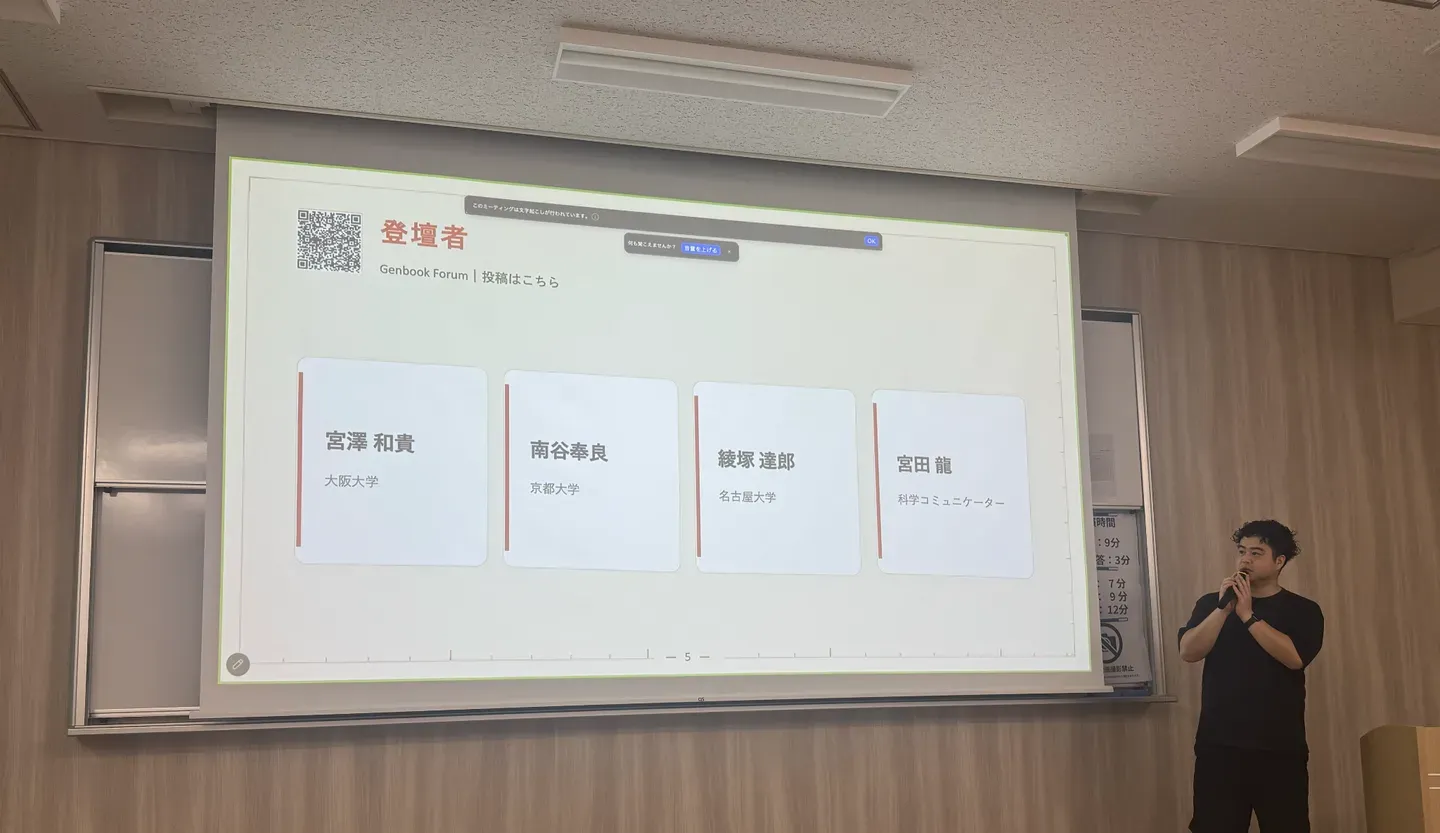
On September 1, 2026, Open Forum 16 of the 44th Annual Conference of the Robotics Society of Japan was held at Kanazawa University as an event open to the public. Titled 「数年後のロボットと私たち — Genbook × SFプロトタイピング」 (Robots and Us in the Coming Years — Genbook × SF Prototyping), the forum was planned by PI Kazuki Miyazawa of The University of Osaka together with his fellow organizers, and supported by the MIRAI Humanoid Project under Moonshot Goal 3.
Miyazawa also wrote the short science fiction story 『季節を渡る』 (Kisetsu o Wataru) for the workshop and gave the research talk on humanoids. Genbook, used for reading and discussion, was developed by Yoshimi Minamitani of Kyoto University, a scholar of English literature.
Science communicators Ryu Miyata and Nagoya University’s Tatsuro Ayatsuka also helped organize the event, with Miyata serving as facilitator throughout.
Drawing on their different areas of expertise, the team used science fiction prototyping—imagining the future through a story—to explore the ethical, legal, and social issues (ELSI) of living and working alongside humanoids together with members of the public.
From humanoid research to our relationships with robots
Miyata opened with an icebreaker inviting participants to share their favorite science fiction works. They posted comments on Genbook, sharing works ranging from manga and novels to animation.
Miyazawa then introduced the current state and outlook of humanoid research. He discussed advances in physical capabilities and the research still needed to realize general-purpose autonomous humanoids that work alongside people in everyday environments. Questions from participants included what it means for a robot to have a human form.
Miyata also led a quiz about imagined accidents involving robots and autonomous vehicles, asking who should bear responsibility. Initially, many participants considered users or manufacturers responsible. When considering robots of the future, however, more participants attributed responsibility to the robots themselves. These concrete scenarios drew attention to the new issues that could arise as robots become more capable.
A short story opens up the conversation
Participants read Miyazawa’s short science fiction story 『季節を渡る』 (Kisetsu o Wataru), then posted their impressions on Genbook. Replies between participants and images generated by the facilitator from their comments provided a basis for examining the story’s society in concrete terms.
Some reflected on their empathy for the robot Haru, or on how a human and a robot could become colleagues by working together. Others asked who would pay for repairs, and how much of a robot’s experience or field of view should be shared with other robots. The story broadened the discussion from technology to people’s roles at work, their relationships with robots, and the arrangements needed to support robot use.
The story is available in Japanese through the forum website.
What challenges lie beyond convenience?
Participants next imagined other robots that might inhabit the story’s world. Ideas ranged from disaster response and laundry to taking children to and from nursery, education, and looking after people. Robots were imagined as companions and sources of advice as well as helpers with practical tasks.
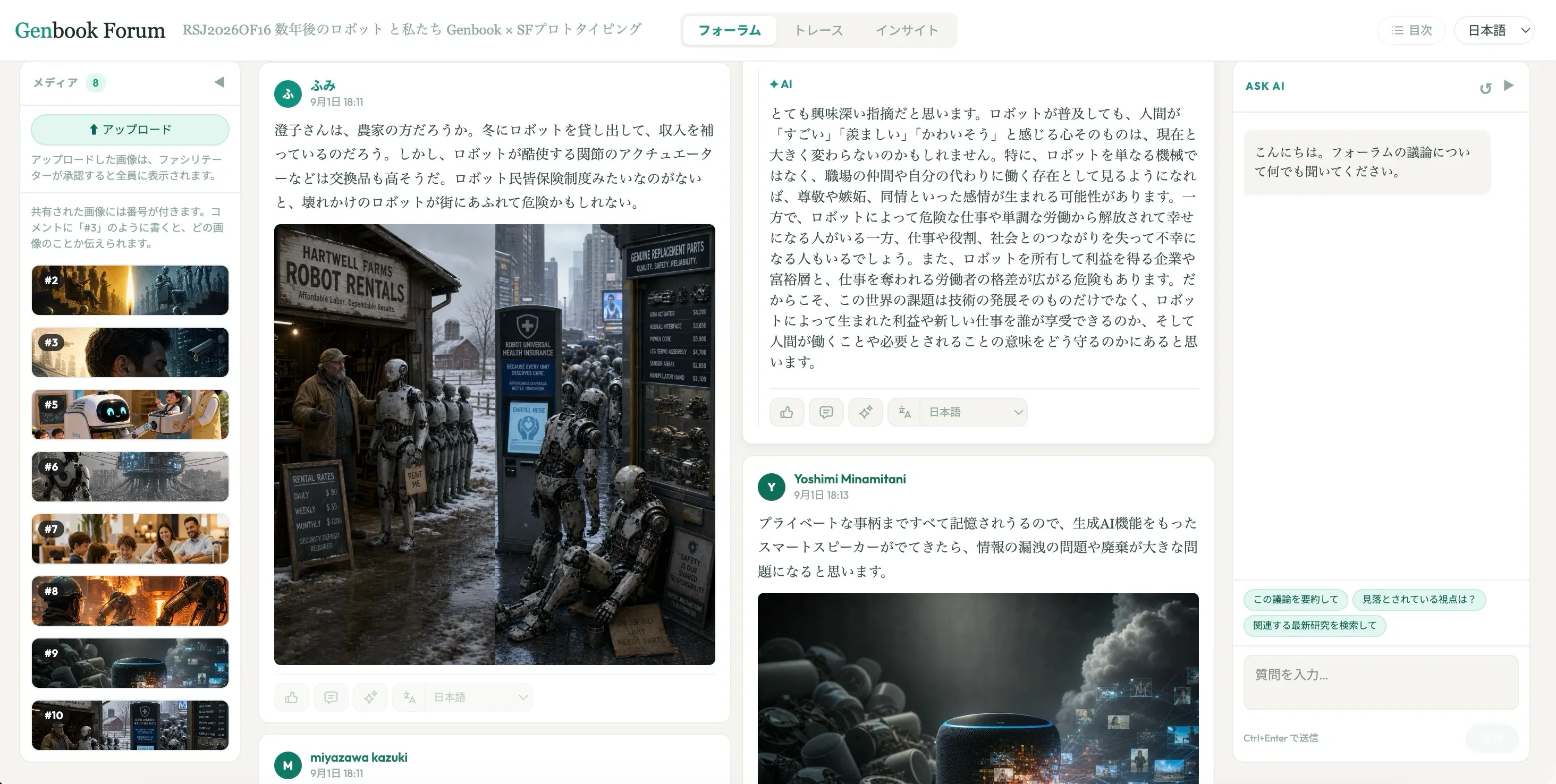
The Genbook Forum interface, showing participant comments, images of a future society generated by the facilitator, and AI replies.
The discussion turned to who would benefit in that society and who would bear the burdens. Genbook’s summary of the comments identifies the following issues, centered on robot ownership, the distribution of benefits, and who bears the burdens and risks:
- Reduced burdens and free time: Robots could reduce dangerous, repetitive, or demanding work, address staff shortages, and support older people and people with disabilities in their activities. Whether people can freely use the time saved also shapes the benefits.
- Ownership and unequal opportunities: Income and bargaining power could diverge between those who own robots and accumulate profits and data, and those who do not. Access to repairs, upgrades, education, and retraining matters alongside the ability to buy a robot.
- Work and human value: Changes to work affect not only income but also people’s roles, sense of achievement, and self-worth. What if the work left to people involves low pay, strict surveillance, and heavy responsibility? How should society support those who lose their roles?
- How robots are treated: Alongside robots’ own happiness and rights, the summary considers how violence or overwork toward robots might affect the ethics and behavior of people around them, including children.
- Memory, surveillance, and privacy: How should recording, access, retention, and data deletion when robots are disposed of be governed? Other issues include information about family members or colleagues who have not consented, and whether data providers share in the benefits.
- Breakdowns, accidents, and responsibility: How should responsibility be shared among manufacturers, owners, and users, taking into account who taught a robot what and in which context? Long-term use also calls for arrangements for inspection, repair, replacement parts, disposal, and insurance.
These issues share two central questions: who receives the benefits of reduced burdens, increased profits, accumulated data, and newly available free time? And how can human value be recognized beyond work? Alongside technological progress, the discussion raised questions about the institutions governing ownership, education, employment, data, and responsibility.
Taking new questions home
The final exercise considered society after the identified challenges had been addressed. One proposal was to share robots as public infrastructure. Other comments raised further challenges, such as how to maintain large numbers of robots years after their introduction. Participants increasingly built on one another’s ideas.
Miyata closed by encouraging participants to take their unresolved questions home. The two-hour session offered a starting point for continued reflection on coexistence between people and robots. For MIRAI Humanoid, it was also an opportunity to consider, together with participants, how its research might connect with everyday life and society.
Event details
- Date and time: September 1, 2026, 16:30–18:30 JST
- Venue: Kanazawa University
- Session: Open Forum 16, 44th Annual Conference of the Robotics Society of Japan
- Organizer: 名古屋大学大学院人文学研究科附属人文知共創センター (the humanities co-creation center at Nagoya University’s Graduate School of Humanities)
- Supported by: MIRAI Humanoid Project · Moonshot Goal 3
- Organizers: Kazuki Miyazawa (The University of Osaka), Yoshimi Minamitani (Kyoto University), Ryu Miyata (science communicator), and Tatsuro Ayatsuka (Nagoya University)
- Facilitator: Ryu Miyata (science communicator)