
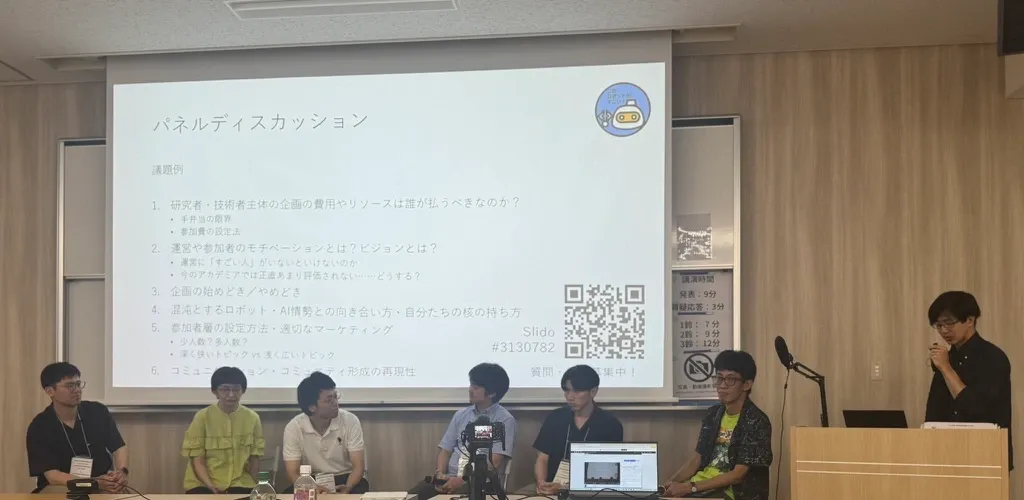
The panelists with moderator Yuki Onishi (far right), a MIRAI Humanoid research collaborator.
On September 1, 2026, Open Forum 15 of the 44th Annual Conference of the Robotics Society of Japan took place at Kanazawa University as an event open to the public. Titled 「繋げる・伝えるロボティクス」 (Connecting People and Communicating Robotics), the forum was supported by the MIRAI Humanoid Project under Moonshot Goal 3. Project collaborator Yuki Onishi of the National Institute of Informatics helped organize the event and served as moderator.
Eleven years of Kono Robo: Satoshi Makita (Fukuoka Institute of Technology)
「このロボットがすごい」 (Kono Robo) was a series held from 2015 to 2025 in which researchers and developers shared their enthusiasm for robotics with the public. In looking back over those eleven years, Satoshi Makita began with the role of outreach in sharing research and nurturing the next generation. Presenting at a conference or making information public does not necessarily reach people who do not attend academic events or have yet to develop an interest in the field. Makita explained the need to give those people an opportunity to discover what makes robotics interesting.
Online streaming offers one route. Even when admission is free, attending in person requires travel expenses and time. A stream can reach people who cannot come to the venue, as well as those who happen upon it on social media. Meeting face to face also offers value that can make the journey worthwhile. Makita argued that event formats should reflect their purpose: reaching a broad audience and creating experiences that depend on being there in person.
Kono Robo itself began with a chance encounter with a stream. In 2015, while resting at home with a cold, Makita watched IPSJ-ONE, a talk event featuring young researchers that appeared on his Twitter timeline. Hearing exciting research talks from his bed made him want to create a similar opportunity within the robotics society. When he proposed the idea, others joined him. Collaborators helped develop the name, design, speaker invitations, and streaming arrangements.
Invitations extended beyond researchers who regularly spoke at academic conferences to robot developers whose work the organizers encountered on Twitter and wanted to hear about. The first event filled its venue. The following year, posts carrying the event hashtag were displayed on a separate screen, bringing questions and reactions from outside the room into the event.
The organizers continued adjusting the number of speakers, talk lengths, and the days and times that made participation easier. A Science Agora spin-off combined talks and exhibits. At the 2018 Chubu University edition, participants joined robot demonstrations on stage, and people gathered around robots and their developers afterward. These were opportunities for exchange specific to attending in person. Talks eventually settled into slots of about 30 minutes, allowing time for both presentations and questions.
In 2020, the annual conference’s open forums were not held because of the pandemic, but Kono Robo went ahead online in December. The format made it possible to demonstrate robots that were difficult to transport directly from their home facilities. In 2021, a speaker appeared as an avatar, expanding the possibilities for participation that an online event could offer.
Streaming continued when in-person events returned in 2022. Graphic recordings by しらかわあずま (Shirakawa Azuma) demonstrated another way to communicate talks through drawings and text. In 2023 and 2024, a challenge was connecting remote and in-person speakers with questions from the venue. Equipment and network conditions varied by location, requiring continued experimentation with the streaming setup. A 2025 edition bringing together robot competition enthusiasts marked a milestone in the series.
Makita closed his retrospective by discussing the substantial online audience and the value of public archives, alongside the difficulty of improving streaming quality. His message was to speak up about what one wants to do and to support others when they propose an idea. Reflecting on the many people who had supported Kono Robo, he also expressed his wish to continue exploring the value of gathering in person.
Science communication: Fumi Seto (Tohoku University)
Fumi Seto looked back at her work communicating robotics and science alongside her research, which she began in graduate school before Kono Robo existed. For Seto, communicating and connecting are intertwined: sharing ideas creates relationships, and those relationships lead to further activities.
One experience that prompted her to communicate was a television reaction to news of ASIMO running in 2004 that amounted to asking whether running was all it could do. A capability that researchers know is difficult could seem obvious to someone looking at a humanlike robot. She was also subsequently told that robots should be easy to explain because people could see what they did.
Yet familiar images from animation and films can lead people to believe they understand a robot after seeing only a few movements or features, creating a gap between their assumptions and the actual technology. Concerned that such misunderstandings could hinder the use of robots in society, Seto began writing about technologies she found interesting on her blog and building loose connections with others through social media.
Making her wish to communicate known led to invitations to write articles and connections with science communicators at other universities. Wanting to hear researchers describe their work in their own words, she helped bring together networks of young researchers for a public seminar aimed at secondary school students. In 2011, this work extended to a journal feature bringing together perspectives from researchers, public relations, and science writing. It reinforced the need for researchers to use their own words to bridge the gap between public expectations and research.
The feature appeared in March 2011, when the Great East Japan Earthquake prompted questions about what robots could do at disaster sites. Today, as running becomes an expected capability, the question turns to what robots can do beyond that. Seto emphasized that respect for earlier research and honest communication remain essential as circumstances change. She encouraged moving from individual enthusiasm toward a shared team vision of whom to reach and what to communicate.
Her final theme was communicating with the possibility of eventually stepping back in mind. Work, health, and personal circumstances change, making it difficult for the same people or team to remain involved with the same energy indefinitely. Handing activities over, bringing them to a close, and starting something new all benefit from records of what was done and why.
Some past articles can still be read, while others have disappeared. Since it is uncertain what will survive, Seto encouraged participants to choose carefully what they want to preserve and give it a form such as an article, video, or journal contribution. She closed by asking people to consider, from the start of an activity, what they might pass on to those who come after them.
KUPAC activities: Takumi Hara (Kyoto University)
Takumi Hara introduced KUPAC, a community based at Kyoto University whose faculty representative is MIRAI Humanoid PI Satoshi Yagi. Its organizers range from undergraduates to early-career researchers. It welcomes participants regardless of affiliation or specialty. Its three main activities are study sessions on Physical AI—AI that acts in the physical world—robot workshops, and development projects.
Hara emphasized practical experience. Loose screws that affect motion and wiring problems that produce unexpected errors become tangible when working with a real robot. One robot-arm workshop let participants experience data collection, training, and testing within a single day.
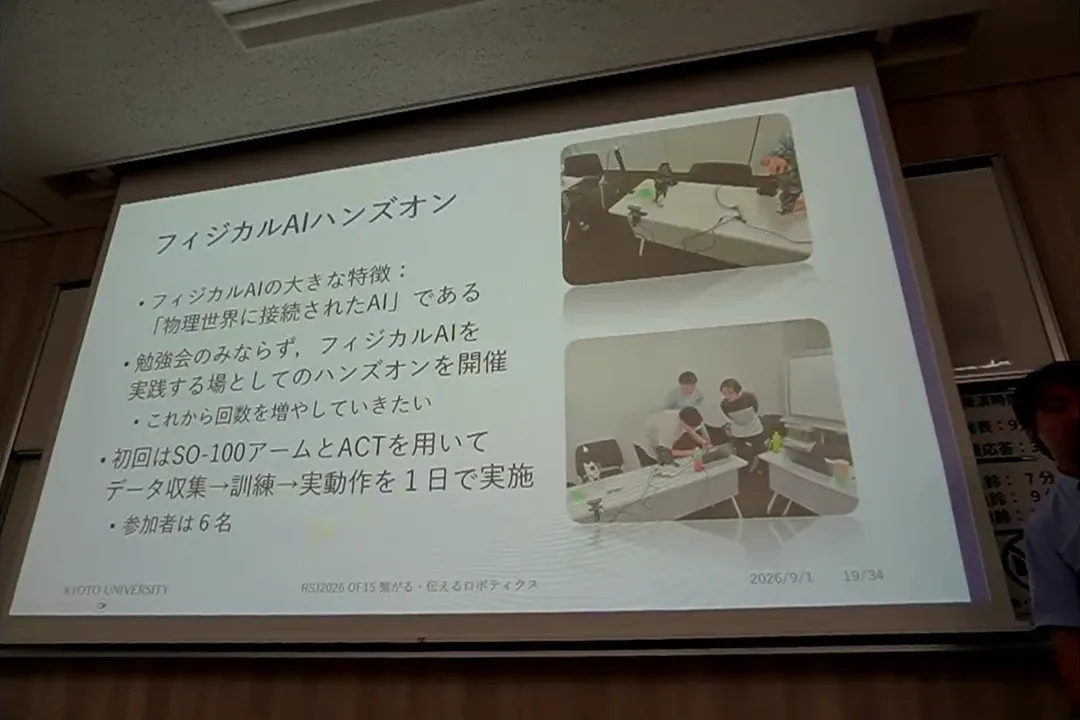
A workshop introduced in KUPAC’s presentation.
Working with companies can give students access to robots they could not easily obtain on their own. Hara described borrowing robots for development projects from companies that had equipment or purchasing resources but were still exploring how to use them. Running robots for extended periods at exhibitions also provided practical knowledge beyond everyday research.
To support continuity, KUPAC has begun welcoming new undergraduates and helping them learn programming, ROS, and robot learning methods from the basics as they join projects.
Hara explained that collaborations with companies depend substantially on support within the university and members who undertake external outreach. The community also values giving each person room to propose and pursue activities, without requiring everyone to align around a single goal. He stressed that other groups need not copy KUPAC’s model: a study group devoted to reading papers can also be valuable.
Challenges extend beyond obtaining equipment to paying for storage and workspace. Passing activities on before graduation, balancing community work with research, and gaining supervisors’ understanding are also part of sustaining a student community.
Running RoboSemi: Kotaro Yoshimoto
Kotaro Yoshimoto introduced the online robotics study group ロボゼミ (RoboSemi), launched in 2020. It aims to bring people together to discuss robotics, whether they work with robots professionally or as a hobby. The disappearance of in-person study groups during the pandemic prompted its creation.
Online meetings can easily become one-way exchanges in which a speaker presents and the audience listens. RoboSemi therefore works to make presenting easier. Sessions are generally not recorded, and presenters determine how widely information may be shared. Talks have no fixed time limit so speakers can explain their work thoroughly. Work in progress, failures, and practice presentations are also welcome. The emphasis is on using a contribution as the starting point for thinking together.
Listeners, in turn, are encouraged to take part in discussion. A small participation fee and a manageable group size support that aim: in a large audience, people may hold back, assuming someone else will ask a question.
Three friends who have known one another since their student days organize the group: Yoshimoto; MIRAI Humanoid research collaborator Yuki Onishi, who also moderated this forum; and 安達波平, who works on field robotics in Shibetsu Town, Hokkaido. They assign responsibility for each meeting. As their lives changed, including moving into employment, they reduced the frequency from monthly to once every two months. The additional preparation time helped make the group’s first in-person event possible.
A free junior category also opens participation to younger people, including high school students who do not have credit cards.
Yoshimoto also described regular participants who share progress reports or ask thoughtful questions. He described the organizers as the group’s most regular participants, creating a group they want to attend.
Newcomers also contribute by presenting on their first visit. Some people discover the group on X, then use its website and hashtag to learn about the atmosphere before joining. The organizers also share their know-how and have begun opening parts of their review meetings to participants.
Organizing ROSCon JP: Hideki Takase (The University of Tokyo)
Hideki Takase introduced ROSCon JP, a technical conference focused on ROS, the open-source platform for robot development.
ROSCon JP is a regional conference organized through a general incorporated association under an agreement with Open Robotics. Translation for keynote talks by leading international contributors also helps make their work accessible to Japanese participants.
For contributed talks, both proposals and presentations are in Japanese. Selection considers relevance to the ROS community, impact, originality, and the extent to which resources such as source code are publicly available. Making work easy for others to use is a contribution to the open-source community.
Registration fees and sponsorship support opportunities for exchange. At the venue, company exhibits attract detailed technical questions and conversations between engineers. Longer breaks allow time to visit exhibits and talk over meals. At the same time, talks are streamed on YouTube and archived, making the information accessible to people who cannot attend.
Takase described the goal as building relationships through detailed discussion in Japanese, then using that experience to participate in international conferences and contribute to development globally.
Takase spoke candidly about the workload. Alongside its volunteer organizing committee, an event management company helps support the scale of the event. The organizers also have a responsibility to provide value commensurate with the fees. He discussed challenges that have emerged through sustaining the conference: meeting the differing expectations of specialists and people just becoming interested in ROS, and bringing in new perspectives as speakers and topics become more familiar.
Panel discussion: Moderator Yuki Onishi (National Institute of Informatics)
All speakers were joined by 南川健志郎 of Kyoto University for the panel, which discussed community operations and continuity, including the division of responsibilities and succession; participation fees and the role of online and in-person interaction; and connections with newcomers and fields such as Physical AI.
Event details
- Date and time: September 1, 2026, 13:00–16:00 JST
- Venue: Room 111, Large Lecture Building 2, Kakuma Campus, Kanazawa University
- Session: Open Forum 15, 44th Annual Conference of the Robotics Society of Japan
- Hosted by: 日本ロボット学会 若手・学生のためのキャリアパス開拓研究専門委員会 (the Robotics Society of Japan’s research committee on career paths for young people and students)
- Supported by: MIRAI Humanoid Project · Moonshot Goal 3
- Organizers: Yuki Onishi (National Institute of Informatics), Satoshi Makita (Fukuoka Institute of Technology), Emiko Uchiyama (University of Tokyo), 山田大輔 (Mitsui & Co. Global Strategic Studies Institute), and 福井孝太郎 (Mitsubishi Electric Building Solutions)